
.png)
If it’s designed for Residential Use,
It Won’t Survive Commercial Demands
___________________________________________________________________
At first glance, some pool equipment may look the same. But what it’s designed for, and what it’s built to withstand, are two very different things.
Residential-grade equipment is made for occasional use. A few swimmers. Limited exposure. Predictable conditions. Commercial and competitive facilities? That’s a completely different environment. High traffic. Constant use. Competitive performance. Continuous exposure to chemicals and the elements.
If equipment isn’t engineered for that reality, it won’t last in it.
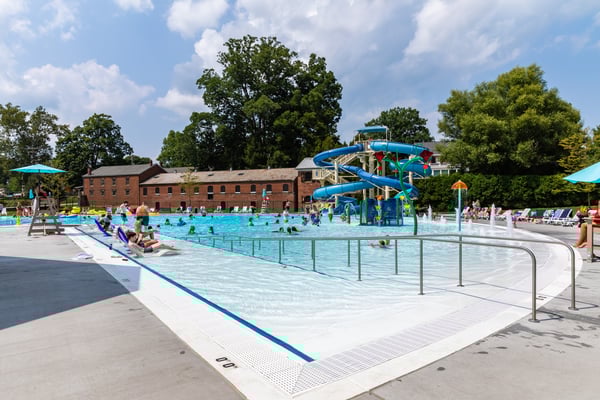
Commercial Pools Demand More
There’s a common misconception that pool equipment is interchangeable, that what works in one setting will work in another. But as Mick Nelson, Co-Founder of Total Aquatic Programming puts it:
“There is a huge difference between a residential pool and a commercial or public pool. In fact, the only similarity is the water.”
From early morning practices to all-day programming, swim meets, lessons, and open swim, commercial pools don’t slow down. Equipment is used repeatedly, often aggressively, and expected to perform consistently every single time.
Equipment built for light use won’t last in a facility that never slows down.
The Problem with “Standard” Equipment
Residential-grade or lower-tier standard equipment may look similar on day one. But over time, the differences in materials, design, and engineering become impossible to ignore, especially with roto-molded products.
While roto molding has its place in aquatic environments, equipment constructed entirely from molded plastic introduces a critical weakness: when one component cracks, splinters, or fails after repeated use, the integrity of the entire unit is compromised.
The issue isn’t always visible upfront; it’s structural.
- Materials that aren’t built to resist corrosion begin to break down
- Designs with multiple failure points start to loosen or fail
- Components wear faster under repeated use
- Performance becomes inconsistent
And in a commercial setting, those issues don’t stay small.
.png?width=500&height=281&name=No%20residential%20equipment%20(3).png)
The Hidden Cost of “Standard” Equipment
What appears to save money upfront often costs significantly more over time. In commercial pool environments, equipment that isn’t built for constant use leads to:
-
More Repairs
-
Weaker materials and common failure points don’t hold up to daily use. What should be reliable becomes something your team has to constantly fix, adjust, or monitor.
-
-
More Downtime
-
When equipment fails or needs service, it disrupts programming, schedules, and user experience. Commercial pools rely on consistency and downtime breaks that rhythm.
-
-
More Replacements
-
Shorter product lifespan means replacing equipment sooner than expected. What seemed like a cost-saving decision becomes a repeated expense cycle.
-
-
More Frustration
-
Staff, coaches, and facility managers are left dealing with ongoing issues. Athletes notice inconsistencies. Operations become reactive instead of reliable.
-
Cheap upfront doesn’t mean cost-effective long term. Or as Mick Nelson puts it:
“Commercial projects that try to save money by using residential parts and equipment are asking for serious problems. They have a very short life span before failing in a commercial application.”
What Commercial-Grade Equipment Should Deliver
Commercial environments expose every weakness, but they also highlight what good design looks like.
Equipment built for commercial and competitive pools should offer:
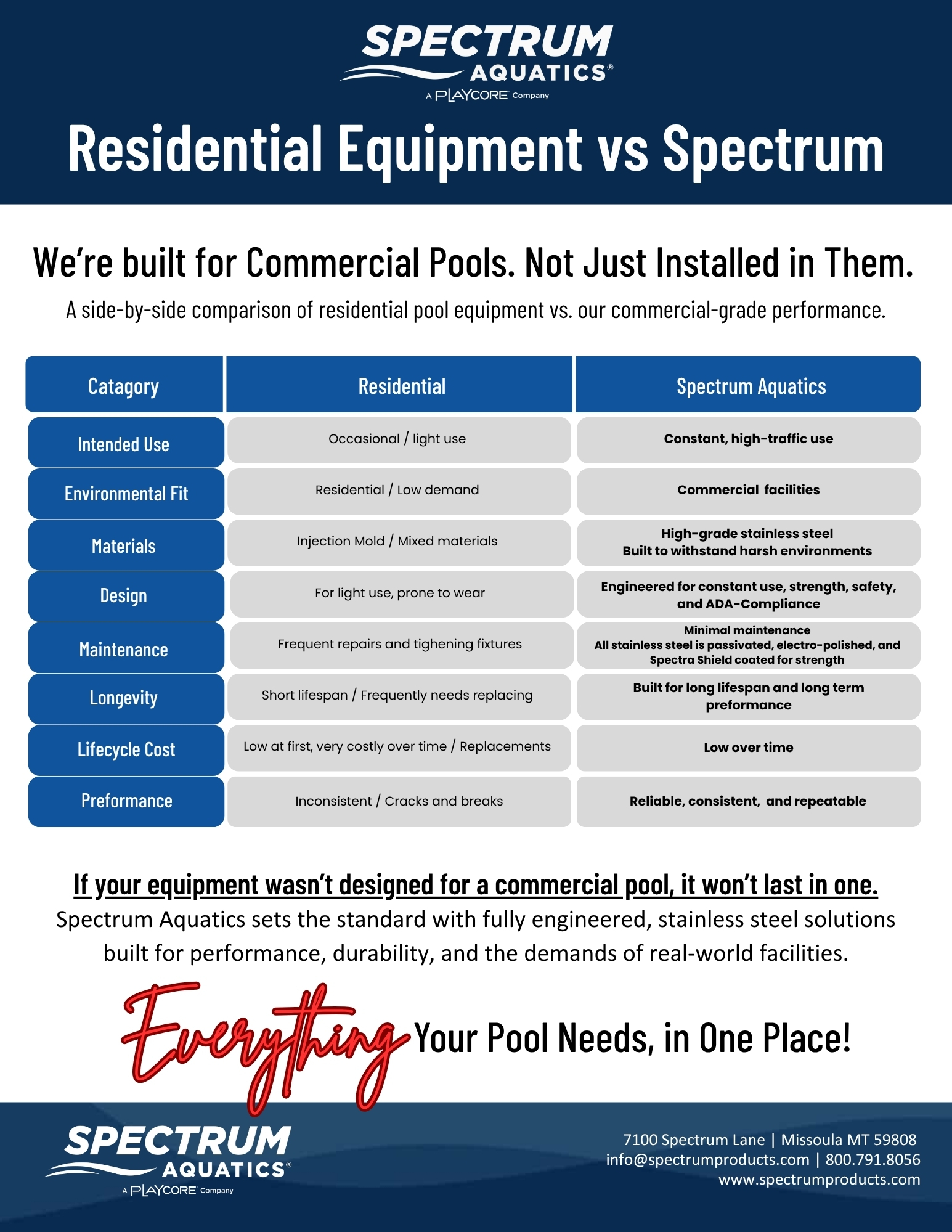
- Stainless steel construction for superior corrosion resistance
- Structural integrity to withstand repeated use and impact
- Engineered for safety and ADA-compliance
- Consistent performance over time and from a variety of users
- Minimal maintenance requirements
- Long-term reliability and value
Download our comparison chart
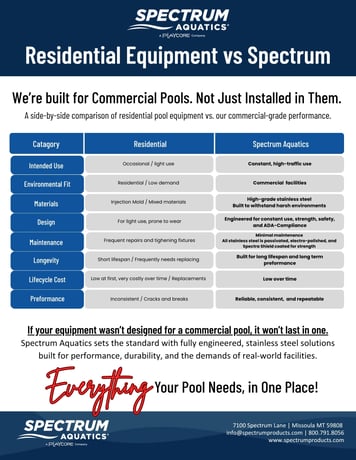 Built for Commercial Pools. Not Just Installed in Them.
This is where Spectrum Aquatics sets the standard for stainless steel commercial pool products.
Every product is engineered specifically for commercial and competitive pool environments, using premium materials, smarter design, and proven systems that perform day after day, year after year.
Every piece of stainless steel is passivated, electropolished, and Spectra Shield-coated for strength and longevity.
Our stainless steel custom rails and ladders, ADA-compliant pool lifts, and recreational features, from slides and zip lines to climbing walls and basketball hoops, are all engineered to work together, creating a complete facility built on strength, reliability, and performance that stands up to constant use.
Remember, you can put commercial-grade equipment in a backyard pool. You can’t expect backyard equipment to survive a commercial one!
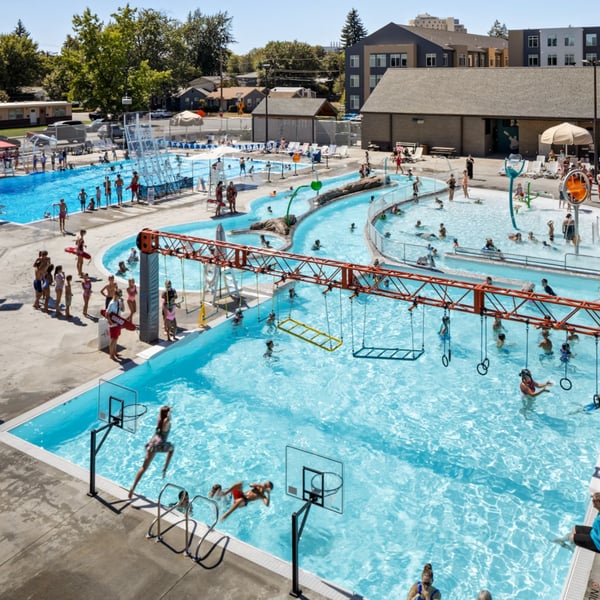
The Bottom Line
Residential equipment has its place, but a commercial facility isn’t it. It’s either built for constant use or it's built to be frequently replaced.
When your pool operates all day, every day, your equipment needs to do the same, because this isn’t the backyard. And if it can’t handle the pressure, it doesn’t belong on your deck.
Contact us for more information on how we can facilitate your commercial pool. Spectrum Aquatics has everything your pool needs, all in one place!
