.jpeg)
Starting Block Requirements
World Aquatics vs. USA Swimming vs. NCAA vs. NFHS
Date: July 2026
If your facility wants the flexibility to host nearly any level of competition from local high school dual meets to elite national events, investing in World Aquatics-compliant starting blocks is typically the most future-ready choice. Spectrum Aquatics' Sprint with Rapid Lock™ is designed to meet World Aquatics requirements while also serving USA Swimming, NCAA, and NFHS competitions, helping facilities avoid expensive equipment replacements later.
At a Glance
| Organization | Typical Competition | Starting Block Requirements | Spectrum Solution |
|---|---|---|---|
| World Aquatics | International | Most stringent certification | ✅ Sprint with Rapid Lock™ |
| USA Swimming | Club Swimming | Uses World Aquatics-based facility standards | ✅ Sprint with Rapid Lock™ |
| NCAA | College Swimming | Competition-ready equipment meeting collegiate standards | ✅ Sprint with Rapid Lock™ |
| NFHS | High School | Safe, competition-approved starting platforms | ✅ Sprint with Rapid Lock™ |
What You'll Learn
After reading this guide, you'll understand:
- Which governing body applies to your facility
- The differences between World Aquatics, USA Swimming, NCAA, and NFHS
- Why buying the "cheapest" starting block can limit future competitions
- How to future-proof your investment
- Why Spectrum Aquatics designed Sprint with Rapid Lock™ to satisfy every level of competition
_____________________________________________________________
Who Sets the Rules for Starting Blocks?
This is one of the most common questions aquatic professionals ask.
The answer is... It depends on who is competing in your pool.
Different organizations oversee different levels of competition, and each publishes facility standards that govern competition equipment. While many requirements overlap, elite international competition generally follows the most rigorous standards, with national and scholastic organizations adapting or referencing those standards where appropriate.
Let's break them down.
What Are World Aquatics Starting Block Requirements?
Quick Answer:
World Aquatics establishes the international standard for competitive swimming equipment, making it the benchmark for Olympic and world-level competition.
Formerly known as FINA, World Aquatics governs:
- Olympic swimming
- World Championships
- International competitions
- World records
Because it represents the highest level of competition, its equipment specifications are among the most demanding in the sport.
Facilities that meet World Aquatics standards are generally well-positioned to host competitions governed by other organizations as well.
World Aquatics Facilities Typically Include
- Adjustable back wedge
- Non-slip competition platform
- Precise dimensions and slope
- Rigid, stable construction
- High-performance materials
What Are USA Swimming Starting Block Requirements?
Quick Answer:
USA Swimming governs competitive club swimming throughout the United States and incorporates facility standards that align closely with World Aquatics while also addressing safety and pool-depth requirements.
USA Swimming sanctions:
- Age Group Meets
- Sectionals
- Futures
- Nationals
Their rulebook places significant emphasis on safe racing starts, minimum water depths, and facility specifications. In many areas, USA Swimming updates its rules to remain consistent with World Aquatics regulations.
What Are NCAA Starting Block Requirements?
Quick Answer:
NCAA swimming uses competition equipment appropriate for collegiate championships and many collegiate facilities choose World Aquatics-compliant starting blocks because they support elite-level competition and athlete expectations.
College swimmers often transition between:
- USA Swimming
- NCAA
- International competition
Because of this, universities frequently select starting blocks that provide athletes with a consistent racing experience across every level of competition.
What Are NFHS Starting Block Requirements?
Quick Answer:
NFHS governs high school swimming and emphasizes safe competition while allowing states some flexibility in adopting certain rules.
NFHS oversees:
- Public high schools
- Private high schools
- State championships
Many high school facilities also host:
- USA Swimming meets
- Masters meets
- Club practices
For that reason, many schools install starting blocks that exceed minimum high school requirements, so the facility remains attractive for additional events.
Comparison Table
| Feature | World Aquatics | USA Swimming | NCAA | NFHS |
|---|---|---|---|---|
| Olympic Competition | ✅ | ❌ | ❌ | ❌ |
| Club Swimming | ❌ | ✅ | ❌ | ❌ |
| College Swimming | ❌ | ❌ | ✅ | ❌ |
| High School Swimming | ❌ | ❌ | ❌ | ✅ |
| Adjustable Wedge | Yes | Common | Common | Common |
| Elite Competition | Yes | Yes | Yes | Varies |
| Spectrum Sprint Compatible | ✅ | ✅ | ✅ | ✅ |
Height Requirements?
Quick Answer:
World Aquatics and USA Swimming generally limit starting platforms to 0.75 meters, or approximately 29½ inches, above the water for meter-course competition. USA Swimming permits up to 30 inches for short-course-yard pools. NCAA also permits a maximum height of 30 inches. NFHS starting-platform requirements must be evaluated together with the pool’s water depth and applicable state association rules.
The important detail is that starting-block compliance depends on the complete installation. The block, pedestal or base, pool deck, gutter configuration, bulkhead, touchpad and operating water level all affect the final platform height.
A starting-block model may be designed for use in compliant competition facilities, but the installed height must still be measured and verified for the governing organization, pool configuration and applicable building or health codes.
| Governing Organization | Permitted Platform Height | How the Height Is Measured | Important Considerations |
|---|---|---|---|
| World Aquatics | 0.50–0.75 meters, approximately 19¾–29½ inches | From the water surface to the front edge of the starting platform | Applies to World Aquatics competition facilities and meter-course competition |
| USA Swimming: Long-Course and Short-Course Meters | 0.50–0.75 meters, approximately 19¾–29½ inches | From the water surface to the front edge of the platform | Starting platforms may be used when the starting-end water depth is at least 4 feet, subject to additional safety and local requirements |
| USA Swimming: Short-Course Yards | Maximum 30 inches | From the water surface to the front edge of the platform | There is no stated minimum platform height in this provision |
| NCAA | Maximum 30 inches | From the water surface to the front edge of the platform | The platform may not project over the water beyond the end of the racing course |
| NFHS | Generally no more than 30 inches, with installation and use also controlled by starting-end water depth | From the water surface to the front edge of the platform | State associations and local codes may impose additional requirements; verify the current NFHS rulebook and state adoption |
World Aquatics uses a minimum-to-maximum range for the front edge of the platform: 0.50 to 0.75 meters above the water surface. USA Swimming applies that same range to long-course and short-course meter pools, while allowing the front edge to be as high as 30 inches in short-course-yard pools.
The current NCAA rule is slightly different: it establishes a maximum height of 30 inches, but does not establish the same 0.50-meter minimum stated for meter-course competition under World Aquatics and USA Swimming rules.
-1.png?width=533&height=399&name=Katharine%20on%20Sprint%20(1)-1.png)
Which Starting Block Should You Buy?
Quick Answer:
Buy for the highest level of competition you may host, not just the meets you host today.
Many facilities begin by thinking only about today's users.
But what happens when your community grows?
What if your swim club earns the opportunity to host a championship meet?
What if your school wants to attract collegiate invitationals?
Replacing starting blocks years later can cost significantly more than selecting the right equipment during construction.
_____________________________________________________________
Why Many Facilities Choose World Aquatics-Compliant Starting Blocks
Instead of wondering whether your starting blocks will qualify for future events, facilities can confidently host:
- High school meets
- USA Swimming competitions
- Collegiate competitions
- Elite competitions where applicable
This approach protects your investment while expanding future programming opportunities.
_____________________________________________________________
How Spectrum Aquatics Meets Every Level
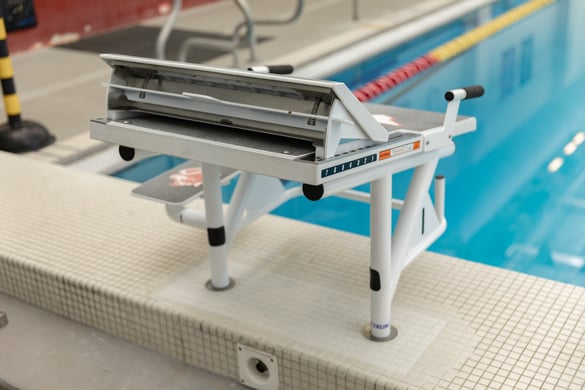
Spectrum designed the Sprint with Rapid Lock™ Starting Block to give facilities one solution for virtually every competitive environment.
Key features include:
- ✅ World Aquatics compliant
- ✅ USA Swimming compatible
- ✅ NCAA compatible
- ✅ NFHS compatible
- ✅ Rapid Lock™ wedge adjustment
- ✅ Adjustable foot wedge
- ✅ Large non-slip platform
- ✅ American-made stainless steel construction
- ✅ Long-term replacement parts availability
- ✅ Retrofit compatibility with many existing bases
Rather than designing a block that simply meets today's minimum requirements, Sprint was engineered to support decades of competitive swimming.
_____________________________________________________________
⭐Expert Tips
-
✔ Build for tomorrow's competitions, not today's.
-
✔ Consider retrofit options if replacing existing blocks.
-
✔ Look for simple wedge adjustment systems that reduce meet delays.
-
✔ Verify replacement parts will be available years from now.
-
✔ Consider the total cost of ownership, not just the purchase price.
What the Experts Say
Facility standards published by World Aquatics and USA Swimming are often used as reference points during aquatic facility planning.
Myth vs. Fact
| Myth | Fact |
|---|---|
| World Aquatics blocks are only for Olympic pools. | Many community pools install them to future-proof their facilities. |
| High schools only need basic starting blocks. | Many high schools host club meets that benefit from higher-level equipment. |
| All starting blocks perform the same. | Wedge adjustment, stability, durability, and serviceability vary significantly. |
| Buying cheaper saves money. |
Higher-quality equipment often reduces maintenance and replacement costs over time. |
💡Did You Know?
Many aquatic facilities serve multiple user groups every year, including swim lessons, USA Swimming clubs, high school teams, collegiate programs, and Masters swimmers. Choosing versatile competition equipment allows one pool to support a much broader range of programming and events.
_____________________________________________________________
Starting Block Buying Checklist
Before purchasing starting blocks, ask:
✅ Which governing body will use my pool?
✅ Could we host larger competitions in the future?
✅ Does the block meet World Aquatics standards?
✅ Is it compatible with USA Swimming, NCAA, and NFHS competition?
✅ Is the wedge quick and easy to adjust?
✅ Will replacement parts still be available years from now?
✅ Can the block retrofit existing anchors or bases?
_____________________________________________________________
Frequently Asked Questions
Can one starting block work for World Aquatics, USA Swimming, NCAA, and NFHS?
Yes. Many premium competition starting blocks, including Spectrum's Sprint with Rapid Lock™, are designed to satisfy the requirements of multiple governing organizations, allowing facilities to host a broad range of competitions.
Do all pools need World Aquatics starting blocks?
No. However, facilities that want maximum flexibility often choose World Aquatics-compliant equipment because it supports current needs while preparing for future events.
Why do elite starting blocks have adjustable wedges?
Adjustable wedges allow swimmers to optimize foot placement for improved starts while accommodating different athlete preferences and body mechanics.
Can older starting blocks be upgraded?
In many cases, yes. Spectrum's Sprint with Rapid Lock™ is designed with retrofit options that can fit many existing installations, helping facilities modernize without replacing every component.
_____________________________________________________________
Final Thoughts
Choosing the right starting block isn't just about meeting today's rulebook, it's about preparing your facility for the next decade of competition.
Whether you're designing a new aquatic center, renovating an existing pool, or replacing aging equipment, selecting a starting block that satisfies World Aquatics, USA Swimming, NCAA, and NFHS expectations gives your swimmers the best possible experience while protecting your investment.
With Sprint with Rapid Lock™, Spectrum Aquatics delivers one starting block engineered for every level of competition, from local dual meets to the world's fastest swimmers.
For more information, please contact us!
