
What Makes a Quality Commercial Pool Handrail?
A Guide to Materials, Manufacturing, and Long-Term Performance
Updated: 11/18/26
_________________________________________________________
Quick Answer: What makes a quality commercial pool handrail?
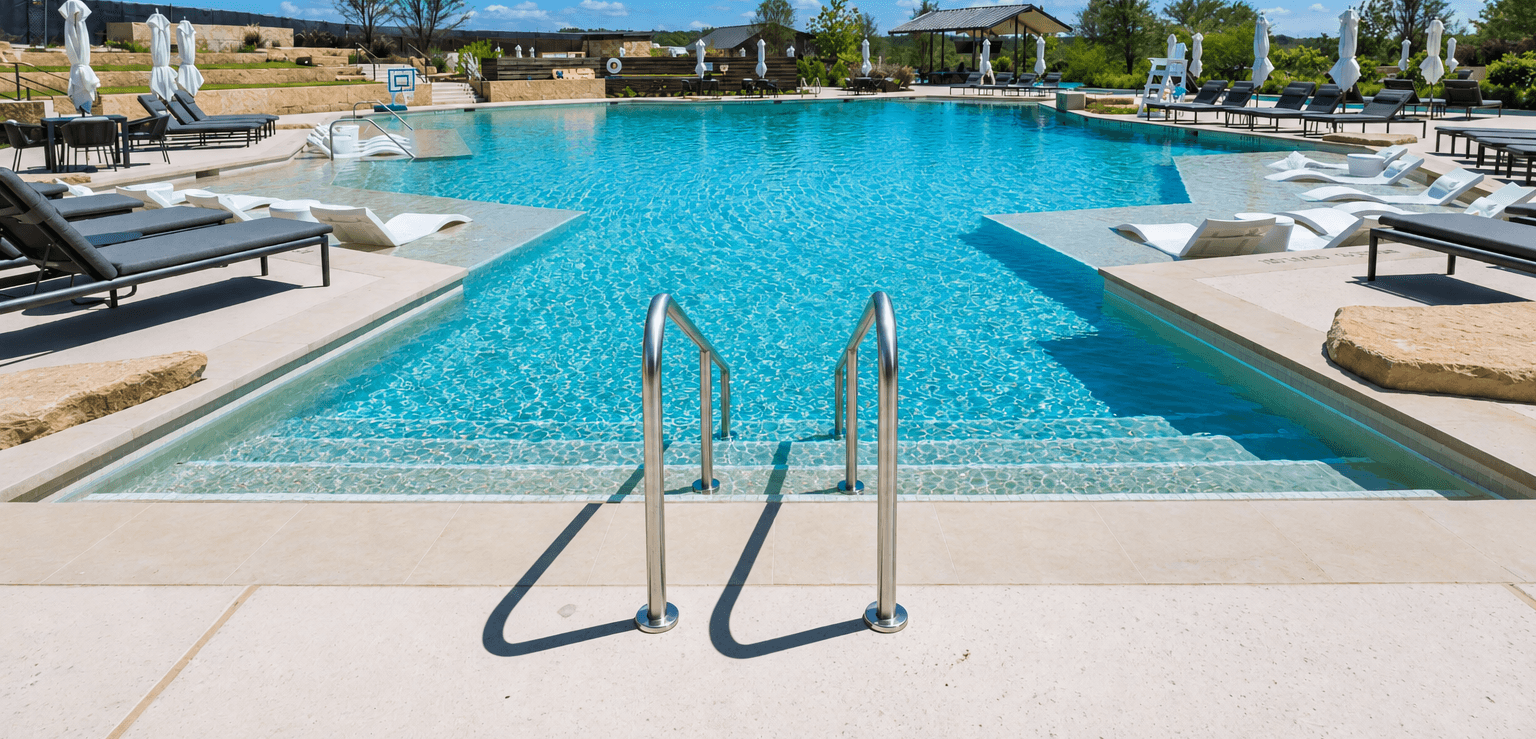
A quality commercial pool handrail combines appropriate stainless steel, properly selected tubing dimensions, durable welded connections, effective surface finishing, and secure installation. Stainless steel grades such as 304L and 316L offer different levels of corrosion resistance, while tubing diameter and wall thickness influence strength and rigidity.
The best handrail is one designed for the facility's environment, intended use, and long-term maintenance requirements.
At a Glance
- Material: 304L and 316L stainless steel are common options for commercial aquatic applications.
- Tubing: Outside diameter and wall thickness both influence handrail performance.
- Fabrication: Proper welding and smooth, finished connections are essential.
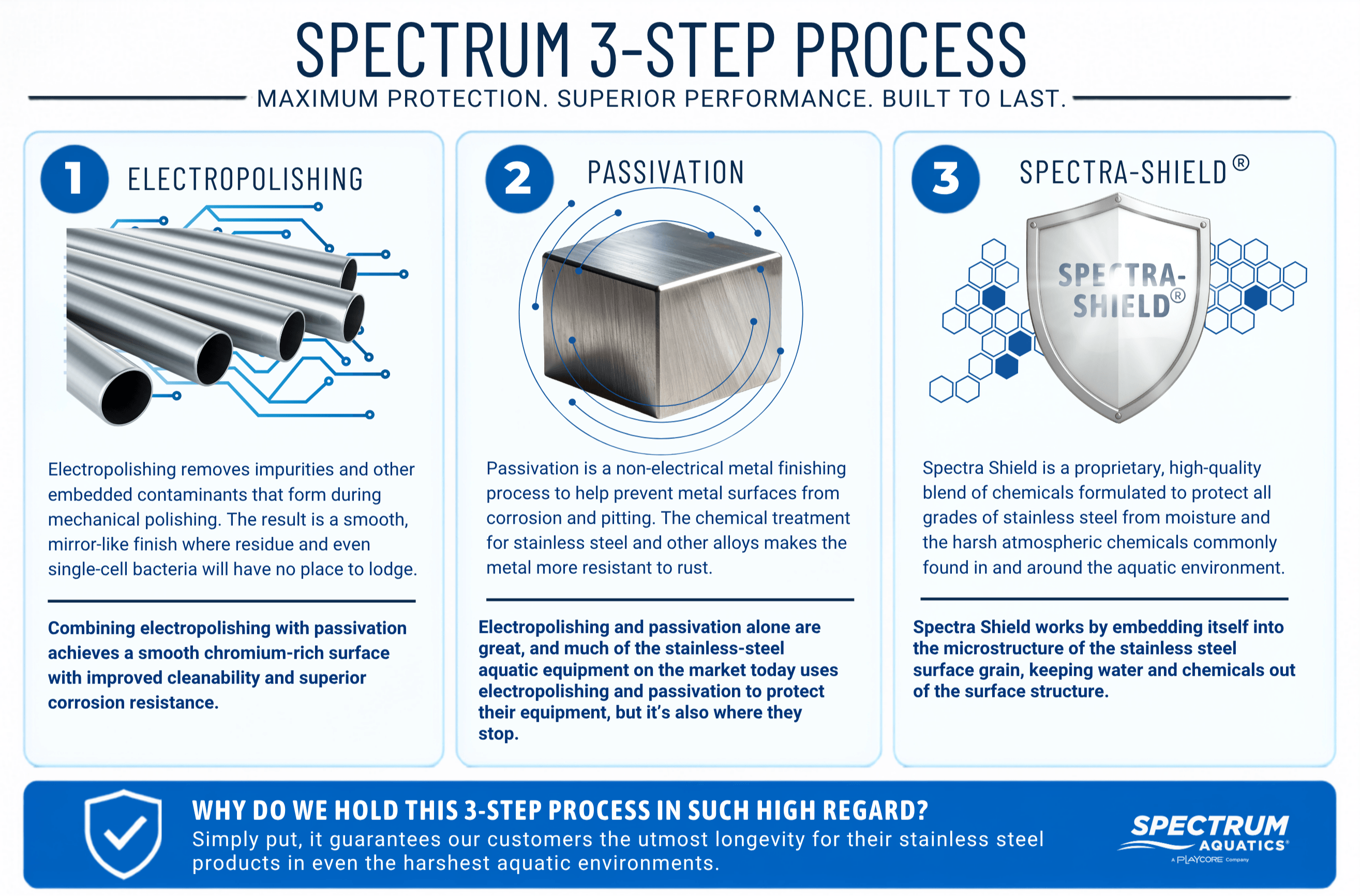
- Surface protection: Polishing, electropolishing, and passivation can help improve surface condition and corrosion resistance. The Spectrum Aquatics 3-Step Process.
- Installation: Appropriate anchors and secure mounting are critical to handrail stability.
- Long-term value: The lowest initial price does not always represent the lowest lifetime cost.
What You'll Learn
Not all stainless steel pool handrails are manufactured the same way.
Two handrails may look nearly identical in a product catalog, but differences in materials, tubing specifications, fabrication methods, and finishing processes can affect how they perform in a commercial aquatic environment.
This guide explains what aquatic professionals should evaluate before purchasing commercial pool handrails, including differences between stainless steel grades, the importance of tubing dimensions, and manufacturing details that aren't always visible in a product photo.
Whether you're replacing existing pool rails or specifying equipment for a new aquatic facility, understanding these differences can help you make a more informed purchasing decision.
_________________________________________________________
1. Understanding Stainless Steel: 304L vs. 316L
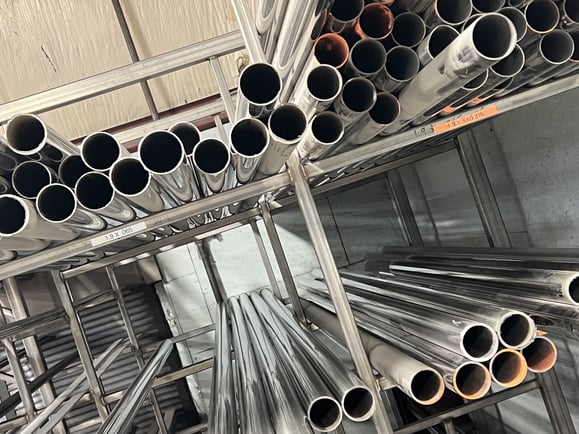
Stainless steel is widely used in commercial aquatic facilities because of its strength, appearance, and corrosion resistance.
However, stainless steel is not a single material. Different grades have different compositions and performance characteristics.
Two common choices for commercial pool handrails are 304L and 316L stainless steel.
What is 304L stainless steel?
304L is a low-carbon version of 304 stainless steel. While both grades offer good general corrosion resistance, 304L's lower carbon content provides an important advantage during welding.
When stainless steel is exposed to high temperatures during welding, carbon can react with chromium to form chromium carbides. This can reduce corrosion resistance in the areas surrounding the weld.
Because 304L contains less carbon than standard 304 stainless steel, it is less susceptible to this process, helping preserve corrosion resistance in welded areas.
This is particularly important for commercial pool handrails, which often require multiple welded connections and are exposed to chemically treated water and humid aquatic environments.
💡Did You Know? The "L" in 304L and 316L stands for "low carbon." These grades typically contain no more than 0.03% carbon, compared with a maximum of 0.08% for standard 304 and 316 stainless steel.
Low-carbon stainless steel doesn't eliminate the possibility of corrosion, but it provides an advantage when manufacturing welded equipment intended for demanding environments.
|
Characteristic |
304 Stainless Steel |
304L Stainless Steel |
|---|---|---|
|
Maximum carbon content |
0.08% |
0.03% |
|
General corrosion resistance |
Good |
Good |
|
Resistance to weld-related sensitization |
Lower |
Higher |
|
Suitability for welded fabrication |
Suitable with appropriate procedures |
Advantageous for welded assemblies |
What is 316L stainless steel?
316L stainless steel contains molybdenum, which improves resistance to localized corrosion, particularly pitting and crevice corrosion in chloride-containing environments.
This can make 316L a preferable choice for more demanding aquatic environments, including facilities with elevated chloride exposure or challenging atmospheric conditions.
However, 316L is not corrosion-proof. Proper fabrication, finishing, cleaning, and maintenance remain important.
304L vs. 316L: What's the difference?
| Characteristic | 304L Stainless Steel | 316L Stainless Steel |
|---|---|---|
| General corrosion resistance | Good | Good |
| Resistance to chloride-related pitting | Lower | Higher |
| Weldability | Good | Good |
| Material cost | Generally lower | Generally higher |
| Common application | Less aggressive aquatic environments | More demanding aquatic environments |
💡Pro Tip: Don't select a stainless steel grade based solely on whether a pool is indoors or outdoors. Water chemistry, airborne chlorides, humidity, cleaning products, and ventilation can all influence corrosion risk.
2. Why Tubing Diameter and Wall Thickness Matter
One of the most overlooked aspects of commercial pool handrail selection is the tubing itself.
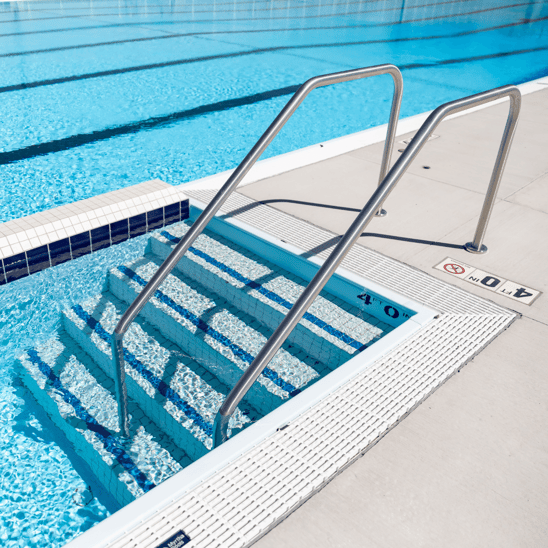
A manufacturer may advertise a handrail as being constructed from 1.50-inch stainless steel tubing. While that describes its outside diameter, it doesn't tell you everything about the rail's construction.
Outside diameter and wall thickness are two different specifications, and both matter.
What is outside diameter (OD)?
Outside diameter refers to the measurement across the exterior of the tubing.
Common commercial pool rail tubing diameters include:
- 1.50-inch OD
- 1.90-inch OD
A larger outside diameter can provide greater bending stiffness when other relevant factors, including wall thickness and material properties, are comparable.
However, a larger diameter does not automatically make a rail better for every application. Grip requirements, accessibility standards, mounting configuration, and intended use must also be considered.
What is wall thickness?
Wall thickness measures the thickness of the stainless steel tubing itself.
Commercial handrails can be manufactured with different wall thicknesses depending on their design and intended application.
For example, Spectrum Aquatics offers tubing options that include:
- .065-inch wall
- .083-inch wall
- .109-inch wall
- .120-inch wall
- .145-inch wall
Not every thickness is necessarily available or appropriate for every rail configuration.
Wall thickness influences the tubing's structural properties, including resistance to bending and local deformation. The finished handrail's performance also depends on its geometry, welds, anchors, and installation.
Why two rails with the same outside diameter may perform differently
Imagine comparing two commercial pool handrails.
Both are advertised as 1.50-inch OD stainless steel.
At first glance, they appear equivalent.
However, one may use thinner-wall tubing, while the other uses a heavier-wall construction selected for the intended application.
Even though their outside diameters are identical, their structural properties may differ.
This is why comparing only tubing diameter and material grade can be misleading.
A complete handrail specification should identify the stainless steel grade, outside diameter, wall thickness, and intended application.
3. The Hidden Cost of Choosing a Pool Handrail Based on Price Alone
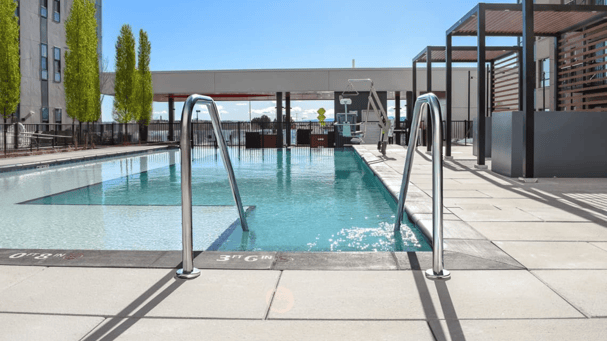
When comparing commercial pool handrails, it's tempting to assume that products with similar appearances and descriptions will perform similarly.
This is especially true when both are advertised as stainless steel and have the same outside diameter. But a lower purchase price doesn't necessarily mean the products are equivalent.
Is a 1.50-inch OD, 304 stainless steel pool handrail a good choice?
It can be, depending on the application.
A properly designed, fabricated, finished, and installed 1.50-inch OD handrail made from 304 stainless steel may perform well in an appropriate aquatic environment.
However, choosing a handrail simply because it is 1.50-inch OD, made from 304 stainless steel, and less expensive can overlook important performance considerations.
The designation "304 stainless steel" doesn't tell you the tubing's wall thickness, the quality of its welded connections, how the surface was finished, or whether the product is appropriate for the facility's exposure conditions.
These details matter.
What should you consider before choosing a lower-cost handrail?
1. Is the stainless steel grade appropriate for the environment?
304 stainless steel offers good general corrosion resistance, but some aquatic environments benefit from the additional localized corrosion resistance of 316L.
2. What is the actual wall thickness?
Two 1.50-inch OD handrails may have different tubing wall thicknesses. Without that information, it's difficult to make a meaningful structural comparison.
3. How are the welds finished?
Weld quality and post-weld finishing can influence both the appearance and corrosion performance of stainless steel components.
4. What surface-finishing processes are used?
A polished appearance alone doesn't establish whether the manufacturer has addressed surface contamination or corrosion resistance through additional processing.
5. What happens if the rail requires premature replacement?
Replacement costs may include more than the price of a new handrail. Labor, mounting repairs, facility access restrictions, and operational interruptions can increase the total expense.
The difference between purchase price and long-term value
A less expensive handrail isn't automatically a poor choice. But it should meet the same functional requirements and be evaluated against comparable specifications.
A lower initial cost becomes less attractive if the rail is poorly suited to the environment, requires more maintenance, or needs replacement sooner than expected.
The better question isn't simply, "Which pool handrail costs less?" It's "Which handrail is properly specified for this facility and offers the best long-term value?"
4. Welding and Fabrication: Details That Make a Difference
Stainless steel fabrication requires more than cutting tubing and joining pieces together.
Commercial pool handrails often incorporate bends, welded connections, and mounting components that must function together as a complete assembly.
Why Welding Experience Matters
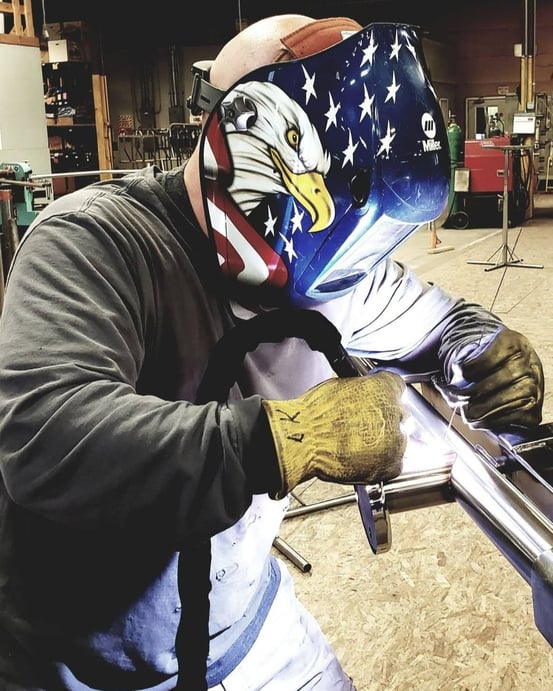
Not just anyone can weld stainless steel properly. Welding is a skilled craft that takes years of practice to master, and the quality of that work can directly affect a commercial pool handrail's performance.
As more manufacturers try their hand at producing rails for aquatic environments, it's important to look beyond the finished product and consider the experience behind its fabrication.
Poor welding techniques can compromise the integrity of welded connections, create areas more susceptible to corrosion, and lead to costly repairs or premature replacement.
At Spectrum Aquatics, our experienced craftspeople understand the importance of properly welded and hand-polished connections. It's an important part of manufacturing stainless steel equipment built for constant use in commercial aquatic environments.
Why weld quality matters
Poor welding practices can introduce defects, surface irregularities, and areas susceptible to corrosion.
Proper fabrication should account for weld integrity, alignment, fit, and the intended loading of the completed rail.
Welded areas also require particular attention because heat from welding can affect the stainless steel surface.
What should finished welds look like?
A well-finished commercial pool handrail should have smooth, consistent transitions without sharp edges or obvious defects.
At Spectrum Aquatics, welds are hand-polished to create a smooth finish and a consistent appearance across the rail.
This attention to detail is especially important for equipment used in areas where swimmers and aquatic staff regularly make contact with stainless steel surfaces.
💡Common Mistake: Assuming a smooth-looking weld automatically guarantees structural integrity. Appearance is important, but proper welding procedures and fabrication quality are equally essential.
5. Surface Finishing: More Than a Shiny Appearance
One of the biggest misconceptions about stainless steel is that its polished appearance alone determines its corrosion resistance.
A mirror-like finish may look impressive, but the processes used to prepare and protect the stainless steel surface are just as important.
That is why Spectrum Aquatics ensures every piece of stainless steel that leaves our Missoula, MT, production floor is treated with our 3-Step Process of electropolishing, passivation, and Spectra-Shield application.
What is polishing?
Mechanical polishing smooths the stainless steel surface and improves its appearance.
A smoother finish can also make cleaning easier and reduce surface irregularities where contaminants may accumulate.
However, mechanical polishing alone doesn't necessarily remove all embedded contamination or restore every area affected by fabrication. Every piece of stainless steel that leaves our Missoula, MT, production floor is hand-polished.
What is electropolishing?
Electropolishing is an electrochemical process that removes a controlled amount of material from the stainless steel surface.
It can reduce microscopic surface irregularities and remove some surface contaminants, helping create a cleaner, smoother surface.
When properly performed, electropolishing can improve the surface condition of stainless steel and support its corrosion resistance.
What is passivation?
Passivation is a chemical treatment that removes free iron and certain other surface contaminants from stainless steel.
It supports the formation and maintenance of the protective chromium-rich oxide layer that gives stainless steel its corrosion resistance.
Passivation is not a coating, and it doesn't make stainless steel immune to corrosion.
What is Spectra-Shield?
Spectra-Shield is Spectrum Aquatics' proprietary protective coating, applied as part of its stainless steel finishing process.
Spectrum's three-step finishing process consists of:
- Electropolishing: Helps create a cleaner, smoother stainless steel surface.
- Passivation: Removes surface contaminants and supports the protective passive layer.
- Spectra-Shield coating: Adds a protective finishing layer.
These steps are designed to help protect Spectrum's stainless steel equipment in demanding commercial aquatic environments.
The quality of the underlying material and fabrication remains important, and no finishing process eliminates the need for proper maintenance.
💡Did You Know? Stainless steel naturally forms a thin, chromium-rich oxide layer that helps protect it from corrosion. Surface contamination, chloride exposure, and improper cleaning can compromise that protection.
6. Why Stainless Steel Pool Handrails Can Still Corrode
Stainless steel is corrosion-resistant, not corrosion-proof.
Commercial aquatic environments can be particularly challenging because stainless steel may be exposed to chemically treated water, humidity, chlorides, and cleaning products.
Even stainless steel that performs well under normal conditions can develop corrosion when environmental exposure exceeds its resistance.
Common factors that contribute to corrosion
-
Chloride exposure: Chlorides can contribute to localized corrosion, including pitting and crevice corrosion.
-
Improper cleaning chemicals: Products containing hydrochloric acid or inappropriate chlorine-based cleaners can damage stainless steel surfaces.
-
Surface contamination: Iron particles introduced during manufacturing, installation, or maintenance may lead to rust staining.
-
Crevices and trapped moisture: Areas that retain moisture and contaminants can become more susceptible to localized corrosion.
-
Poor ventilation: Indoor aquatic environments with inadequate air handling can expose equipment to aggressive atmospheric conditions.
Does 316L eliminate corrosion concerns?
No. 316L generally offers better resistance to chloride-related localized corrosion than 304L, but it can still corrode under sufficiently aggressive conditions.
Selecting the appropriate stainless steel grade is an important first step, but long-term performance also depends on the finished product and its environment.
7. Proper Installation: A Quality Rail Needs a Quality Connection
Even a well-manufactured handrail can perform poorly if it isn't properly installed.
The rail's mounting system must be appropriate for the surrounding structure and intended loads.
What should you evaluate?
- Anchors: Are they compatible with the rail, deck conditions, and intended installation?
- Mounting configuration: Does the installation provide the required stability?
- Deck structure: Can the supporting structure accommodate the rail's anticipated loads?
- Alignment: Is the handrail positioned for safe and comfortable use?
- Applicable standards: Does the completed installation meet relevant accessibility, building, and safety requirements?
For accessible routes and pool entry systems, handrail dimensions and positioning may be governed by applicable standards.
This is particularly important when replacing existing equipment. A new handrail should not be selected solely because its tubing diameter matches the original.
💡Pro Tip: Before ordering a replacement rail, verify the existing anchor dimensions, mounting configuration, and deck conditions. A rail that looks similar in a catalog may not fit the existing installation.
8. When Is a Custom Commercial Pool Handrail the Better Choice?
Not every aquatic facility can accommodate a standard handrail configuration.
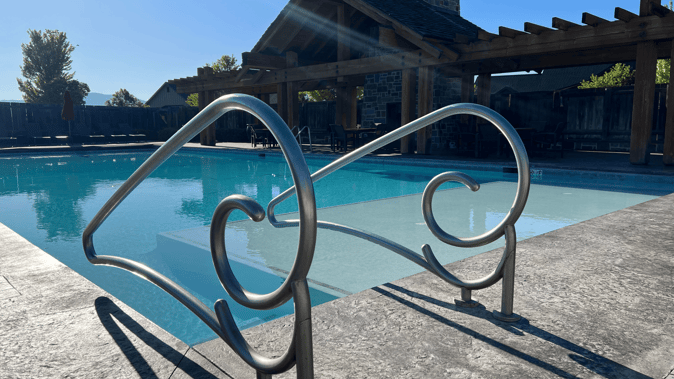
Renovations, unusual deck layouts, accessibility requirements, and existing structural conditions can create situations where a custom-fabricated rail is the more appropriate solution.
Common reasons to consider custom fabrication
- Existing anchors or deck conditions require a nonstandard configuration.
- Pool entry stairs have unique dimensions.
- The facility needs a particular rail geometry or mounting arrangement.
- A renovation requires equipment to fit around existing structures.
- Standard configurations don't adequately address the intended use.
- The facility wants a certain design aesthetic.
Custom fabrication allows the handrail to be designed around the actual application rather than forcing the application to accommodate a standard product.
Spectrum Aquatics manufactures both standard and custom stainless steel pool rails at its facility in Missoula, Montana.
With multiple tubing sizes, wall thicknesses, and fabrication options available, Spectrum can help aquatic professionals identify a suitable configuration for their project.
9. Maintaining Commercial Pool Handrails
Even high-quality stainless steel requires routine maintenance.
Proper cleaning helps remove deposits and contaminants that can affect the appearance and corrosion resistance of the surface.
Recommended maintenance practices
-
Rinse and clean regularly. Use fresh water and appropriate cleaning products to remove deposits from exposed surfaces.
-
Avoid aggressive chemicals. Do not use hydrochloric acid, steel wool, or cleaning products that can damage or contaminate stainless steel.
-
Inspect welded connections and mounting points. Look for changes in appearance, movement, damage, or signs of corrosion.
-
Address staining promptly. Rust-colored staining doesn't always indicate structural failure, but it should be investigated before conditions worsen.
-
Follow the manufacturer's instructions. Cleaning recommendations may differ depending on the stainless steel grade, finish, and protective coatings.
A documented maintenance routine can help facility operators identify problems early and protect their equipment investment.
10. Quick Decision Guide: Choosing the Right Commercial Pool Handrail
| If your priority is… | Evaluate… |
|---|---|
| Corrosion resistance | Stainless steel grade, environmental exposure, and surface finishing |
| Structural performance | Tubing diameter, wall thickness, rail geometry, and mounting |
| Long-term value | Material specifications, finishing, maintenance, and potential replacement costs |
| Accessibility | Applicable dimensional requirements, grip characteristics, and installation |
| Replacement compatibility | Existing anchors, rail dimensions, and deck conditions |
| Custom fit | Fabrication capabilities and project-specific requirements |
No single specification determines the quality of a commercial pool handrail.
The best results come from evaluating how the material, construction, finishing, and installation work together.
11. Myth vs. Fact: Commercial Pool Handrails
-
Myth: All stainless steel pool handrails are essentially the same.
-
Fact: Stainless steel grade, tubing dimensions, fabrication, and finishing can vary considerably between products.
-
-
Myth: A 1.50-inch OD handrail is always too small for commercial use.
-
Fact: A 1.50-inch OD handrail can be appropriate for certain applications. Suitability depends on its complete design, required loads, and applicable standards.
-
-
Myth: 316L stainless steel will never rust.
-
Fact: 316L offers improved resistance to certain forms of corrosion but is not immune to corrosion.
-
-
Myth: A polished handrail doesn't need maintenance.
-
Fact: All stainless steel pool equipment benefits from appropriate cleaning and inspection.
-
-
Myth: The least expensive stainless steel handrail provides the best value.
-
Fact: Initial cost is only one consideration. Material suitability, fabrication quality, installation, and maintenance requirements all contribute to long-term value.
-
12. Questions to Ask Before Buying a Commercial Pool Handrail
Before comparing prices, ask the manufacturer or supplier the following questions.
Commercial Pool Handrail Buying Checklist
- What grade of stainless steel is used: 304, 304L, 316, or 316L?
- What is the tubing's outside diameter?
- What is the tubing wall thickness?
- Is the rail designed for the intended application and loading?
- How are the welded connections fabricated and finished?
- Is the stainless steel mechanically polished, electropolished, or passivated?
- Is an additional protective coating applied?
- What mounting hardware or anchors are required?
- Does the configuration meet applicable accessibility and building requirements?
- What cleaning and maintenance does the manufacturer recommend?
- Can the manufacturer provide custom configurations if necessary?
- What warranty coverage and technical support are available?
💡Ask Yourself: Am I comparing two handrails with equivalent specifications, or am I comparing products that only look similar?
_________________________________________________________
13. Frequently Asked Questions About Commercial Pool Handrails
What is the best stainless steel for commercial pool handrails?
Both 304L and 316L can be suitable for commercial pool handrails. The appropriate grade depends on water chemistry, atmospheric exposure, cleaning practices, and other environmental conditions. 316L generally provides greater resistance to chloride-related localized corrosion.
Is 304 stainless steel good for swimming pools?
304 stainless steel can be appropriate for some swimming pool applications. However, more aggressive aquatic environments may benefit from 316L. The choice should account for the facility's actual exposure conditions and the manufacturer's recommendations.
What is the difference between 304 and 304L stainless steel?
304L has a lower maximum carbon content than standard 304, which helps reduce susceptibility to certain types of corrosion associated with welding. Both are austenitic stainless steels with similar general corrosion resistance.
Is a 1.50-inch pool handrail strong enough for commercial use?
It can be, but outside diameter alone does not establish structural adequacy. Wall thickness, material properties, rail geometry, attachment methods, and required loads must all be considered.
Does thicker stainless steel tubing make a better pool handrail?
Greater wall thickness can improve certain structural properties when other factors are equal. However, thicker tubing isn't automatically necessary or preferable for every application. The rail should be engineered and specified for its intended use.
Why do stainless steel pool handrails develop rust-colored stains?
Rust-colored staining may result from surface contamination, chloride-related corrosion, improper cleaning chemicals, or other environmental factors. Identify the cause before selecting a cleaning or corrective treatment.
What is the benefit of electropolishing stainless steel?
Electropolishing removes a controlled amount of surface material, reducing microscopic irregularities and some contaminants. When properly performed, it can improve surface condition and contribute to corrosion resistance.
Are custom pool handrails more expensive than standard rails?
Custom fabrication may involve additional design and manufacturing costs. However, it can be a practical solution when standard products don't fit existing conditions or project requirements.
How often should commercial pool handrails be inspected?
Handrails should be included in the facility's routine equipment inspection and maintenance program. Inspection frequency should reflect usage, environmental exposure, applicable requirements, and manufacturer guidance. Address any looseness, damage, or developing corrosion promptly.
What should I look for when comparing commercial pool handrail manufacturers?
Compare material grades, tubing dimensions, fabrication quality, finishing processes, installation requirements, and available technical support. Request complete specifications rather than relying on appearance or purchase price alone.
_________________________________________________________
Final Thoughts: Quality Goes Beyond the Surface
A commercial pool handrail may seem like a relatively simple piece of equipment, but its performance depends on much more than its appearance.
Stainless steel selection, tubing dimensions, fabrication, surface finishing, and installation all contribute to the finished product.
For aquatic professionals, understanding these details makes it easier to compare products fairly and select equipment suited to the facility's needs.
At Spectrum Aquatics, we believe quality begins with understanding how commercial pool equipment is made. Our stainless steel rails are manufactured in Missoula, Montana, with attention to material selection, fabrication, and finishing.
From standard pool rails to custom-fabricated solutions, our goal is to provide equipment built for constant use in commercial aquatic environments.
Looking for commercial pool handrails?
Explore Spectrum Aquatics' Rails and Ladders or contact our team to discuss the right stainless steel rail configuration for your facility.
